Treatments
Treatments
The heart sees what the eyes cannot recognise.
Chinese medicine seeks to look beyond the symptom, understand connections and search for the root of an imbalance.
This idea forms the foundation of my work. Even when symptoms appear similar, the person behind them is always unique.
In my practice, I combine different treatments from Traditional Chinese Medicine with the gentle and precise techniques of Japanese acupuncture. I choose the approach not according to a fixed formula, but on the basis of an in-depth conversation, a careful assessment and your personal needs.
The result is individual treatment centred on you as a person, rather than on a particular method.
A first insight into my work.
Acupuncture
Acupuncture is one of the best-known treatments in Traditional Chinese Medicine and has been practised for more than two thousand years.
According to Chinese medicine, pathways known as meridians run through the body. Acupuncture points lie along these pathways and are intended to influence the flow of Qi and establish a balance between Yin and Yang.
In acupuncture, very fine needles are placed at selected points on the body. In my practice, I combine Chinese and Japanese acupuncture techniques, as both traditions have their own characteristics and, for me, complement each other in valuable ways.
Japanese acupuncture in particular often uses very fine, gentle and precise techniques. These include Teishin, a small instrument, often made of silver or gold, used instead of an acupuncture needle without piercing the skin.
Moxibustion
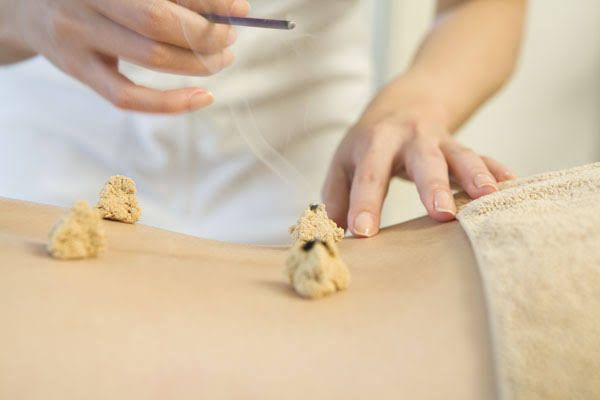
Moxibustion, also known as moxa, is a treatment in Chinese and Japanese medicine with a history spanning thousands of years. Dried, finely prepared mugwort (Artemisia) is allowed to smoulder to apply targeted warmth to selected acupuncture points or areas of the body.
In Traditional Chinese Medicine, moxa is used to dispel cold, strengthen Yang and tonify Qi and blood. Traditionally, it is also used for exhaustion, muscle tension and various kinds of pain.
Moxibustion can complement acupuncture or be used on its own instead of needling. Different techniques are used, including the especially fine Japanese rice-grain moxa, and direct and indirect moxibustion such as moxa cones and needle moxa.
Cupping
Cupping involves placing special cups on the skin and creating a vacuum inside them. This gently lifts the skin and the tissue beneath it. During cupping massage, the cups are moved slowly over the skin with a little oil.
In Traditional Chinese Medicine, cupping is used to stimulate the flow of Qi and blood, release stagnation and encourage inner balance. Traditionally, it is used for back problems and muscle tension, and to support the body's defences, for example in recurring infections.
Qi Gong Tuina
Qi Gong Tuina is a particularly gentle and attentive approach in Chinese medicine, centred on subtle perception of the body's internal processes.
A key foundation is consciously 'listening' to the body. This is not ordinary hearing, but a sensitive perception of Qi movements, their rhythms and changes. Through calm, attentive contact, these movements are carefully followed without imposing anything on the body.
According to Chinese medicine, this can reveal disharmonies in Qi and support its harmonious movement. The treatment is characterised by calm, attentiveness and a particularly sensitive form of bodywork.
Engaging Vitality
Engaging Vitality combines the foundations of East Asian medicine with sensitive assessment techniques drawn partly from osteopathy. At its heart is the ability to perceive the body's subtle movements and rhythms through attentive touch.
This particular form of perception allows acupuncture points to be selected not only on the basis of their traditional effects, but also by taking the body's immediate responses into account. In this way, acupuncture can be tailored very precisely to each individual. The focus is not on a fixed treatment protocol, but on what the body reveals at that moment.
Nutrition
In Traditional Chinese Medicine, nutrition is considered an important part of health and wellbeing. What matters is not only what we eat, but also when we eat, how our meals are prepared and how individual foods affect our bodies.
The aim is to encourage inner balance through mindful, balanced nutrition and to adapt the diet to individual needs. The focus is not on strict rules or short-term diets, but on an approach to eating that fits everyday life, can be sustained in the long term and supports the body as well as possible.